

Hope Through Rupture

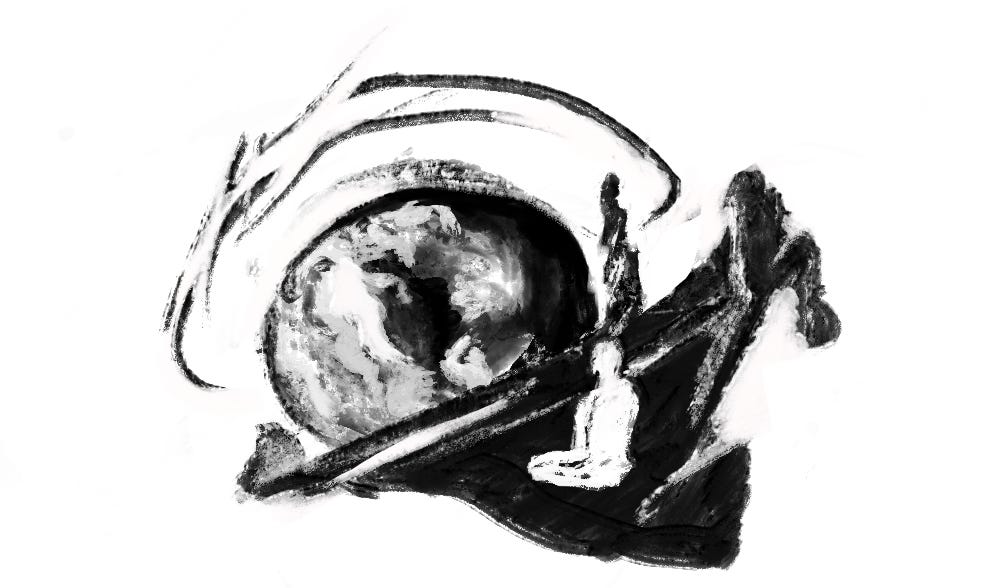
This week’s Crisis and Transition post, “We’ve Been Dealt the Best Hand Possible — Really,” attempts something bold: offering hope in the face of what looks like civilizational unraveling.
Through what Nate Hagens calls a wide boundary lens, the crises before us appear overwhelming. Democratic erosion. The rise of fascism. Economic fragility. Climate destabilization. Planetary boundaries crossed. The post does not soften any of this. Instead, it suggests that the pathway to a life-centered society runs directly through these upheavals.
The structure is deliberate, unfolding in three acts.
First, the rise and eventual fall of American fascism. The argument is not that fascism itself is hopeful, but that the struggle against it awakens capacities that comfort suppresses. The threat forces solidarity. It pushes people out of complacency. It reveals that democracy is not self-sustaining but dependent on an engaged, organized populace. Even the internal contradictions within the MAGA coalition may eventually surface, exposing the tension between populist grievance and oligarchic power. Disillusionment, painful as it may be, can clear ground for something more honest.
Second, economic collapse. The post suggests that a severe downturn, while devastating, could expose the unsustainability of capitalism’s growth imperative. The metaphor of the “Wile E. Coyote moment” captures a system suspended over empty space. When the fall comes, it will not be gentle. Yet crisis has a way of revealing contradictions that stability conceals. Bankrupt enterprises could become worker owned. Cooperative models could expand. A life-centered economy, which now feels implausible, might become a practical necessity under new conditions. Paradigm shifts rarely occur during comfort.
Third, ecological reckoning. Drawing on Gregory Bateson’s insight about the difference between how nature works and how humans think, the post widens the frame beyond politics and economics. Gaia does not negotiate with human ideology. When planetary boundaries are crossed, feedback follows. Ecological destabilization may force a worldview shift that voluntary reform has not achieved. Humanity may be compelled to relinquish the illusion of separation and rediscover its embeddedness within living systems.
Across all three acts, the underlying theme is consciousness.
Fascism forces solidarity.
Collapse forces economic imagination.
Ecological disruption forces humility about our place within the living world.
The title’s claim that we have been dealt the best hand possible is not about comfort or minimizing suffering. It points to the idea that deep distortions require equally deep pressures to surface and unwind. The crises we face are not random. They are revealing the limits of the systems we have built and the assumptions we have carried.
Hope here is not optimism that we will avoid pain. It is confidence that humanity retains the capacity to respond meaningfully. Beneath our destructive patterns lies the ability to learn, to recalibrate, and to choose differently.
History suggests that civilizations do not simply fade; they pass through thresholds. Those thresholds clarify what must fall away and what deserves to endure. In that sense, crisis can strip illusion while also revealing interdependence. It can unsettle what is unsustainable while strengthening what is essential.
The question is not whether crisis will come. It already has.
The question is who we will become in response.
Perhaps that is the deeper meaning of being dealt the best hand possible. Not that this moment is fortunate, but that it is formative. It is shaping us. It is revealing what truly matters and what cannot endure.
Hope, then, is not denial of difficulty. It is the quiet trust that human beings are capable of responding to what confronts us. That pressure can deepen solidarity. That limits can awaken creativity. That even amid disruption, something more life aligned can take root.
If we move toward one another rather than away, if we listen more carefully to the living world and to each other, then what feels like rupture may yet become reorientation.
And perhaps that is where credible hope lives now.
Read the full post here.
Toward a more just and loving world.

Christy, I remain hopeful. I understand that we were going to go through some really awful times; however, I feel extremely helpless right now. He has attacked Iran without Congressional approval. Congress holds the Constitutional authority to declare war and he just did it anyway! He is out of control and even though we hear all of those in power say how he has broken this law and that law, nothing is being done to rein him in. I am so very sick of all of it! I continue to do the work that I am able to do, but I feel it is just not enough. Thank you for clarifying the process we are going through. My hope is that the majority of Americans will move us in a better direction.
Thank you, Christy. As someone who has spent years studying prehistory, I’ve come to see that what truly enabled our survival as a species is our deep-rooted capacity for altruism and compassion. If we had lived in constant conflict, humanity would never have endured the 300,000 years of our modern existence. Each of us carries within us this ancient ability to live in harmony with life itself—and to trust that we are capable of doing so.